Why Your Hardwood Floors Are Separating Right Now, And Why October Is the Culprit
Most homeowners expect summer to be the stressful season for hardwood floors. The humidity warnings, the swelling, the squeaks get blamed on July and August. But October is quietly harder on your floors than any summer month, and almost no one talks about it. If you turned on your heat this week and now you're noticing thin gaps appearing between your boards, you're not imagining things. You're watching physics happen in real time.
Homeowners across Connecticut notice this every fall, and questions about hardwood floor refinishing in Connecticut spike in October for a reason. Floors that looked fine in September suddenly show separation. The question we get most often is simple: is this damage, or is this normal?
October Hits Hardwood Harder Because the Swing Is Steeper Than Summer
The problem isn't the cold. It's the speed.
During summer, humidity rises gradually over weeks. Your floors absorb moisture and expand slowly, giving each board time to adjust relative to its neighbors. The process reverses in fall, but the timing is completely different. Outdoor humidity in Connecticut drops steadily through September. Then the furnace kicks on in October. When forced-air heat starts running through a house that was at 65 percent relative humidity two weeks ago, indoor humidity can plunge to 30 percent or lower within days.
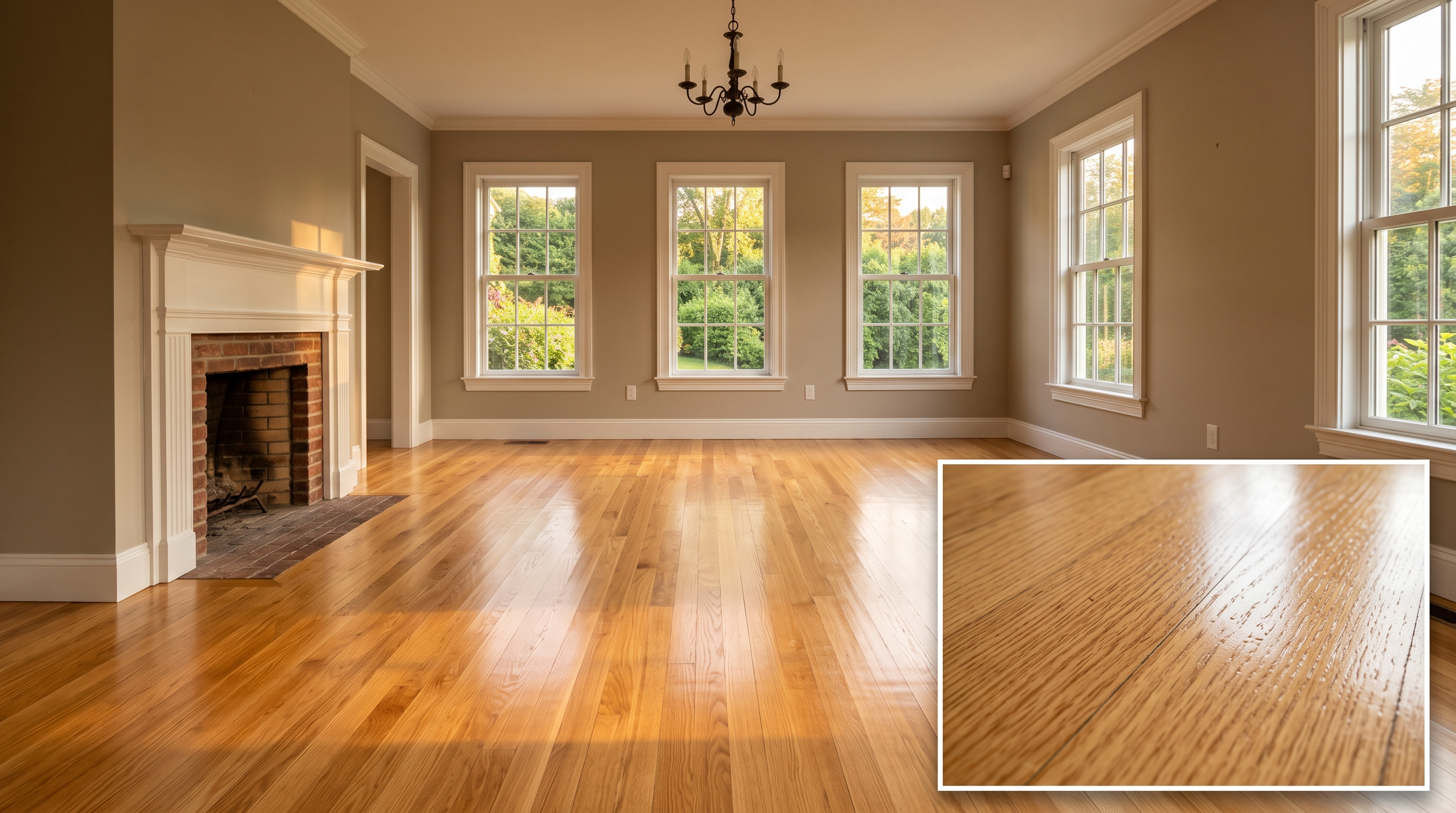
Wood responds to its immediate environment. Hardwood boards lose moisture from their cells, and as they do, they physically narrow. A 3-inch red oak board shrinks measurably across its width. Multiply that across 40 boards laid side by side in a living room and you have visible gaps at the joints. This is the steepest single humidity swing most Connecticut floors experience all year. It happens in a compressed window of two to four weeks, which is exactly why it catches people off guard every time.
The Gaps You're Seeing Right Now Probably Don't Require Refinishing
Here is the most important thing to know: gaps that appear in October and close again by April are seasonal movement. They are not structural failure. They are not a sign that your refinishing job was done wrong. They are not a reason to file a complaint with your contractor.
We regularly see homeowners who convinced themselves their newly refinished floors were defective because gaps appeared two months after the work was done. The floors were fine. The October furnace cycle had simply arrived on schedule.
What distinguishes normal seasonal movement from a real problem is pattern and proportion. Gaps that appear evenly across the floor, affect multiple boards in a consistent way, and close as humidity returns in spring are seasonal. Gaps that are localized to one area, grow progressively wider across multiple seasons, or appear alongside cupping or crowning of the boards tell a different story. Those patterns point to a moisture source, a subfloor issue, or an acclimation problem at the time of installation.
If you want to understand what the installation process should include to prevent acclimation problems, flooring installation mistakes to avoid covers the steps that separate a floor that performs long-term from one that doesn't.
What Happens to a Recently Refinished Floor in October
A freshly refinished floor behaves exactly like any other hardwood floor in October. The finish does not prevent the wood from breathing. That is intentional. A finish seals the surface against spills and abrasion, but wood continues to exchange moisture with the air through its cells. This is what gives hardwood its longevity, and it is also what makes it respond to seasonal shifts.
If your floors were refinished in late summer or early September, you may be noticing October gaps for the first time and attributing them to the refinishing work. The timing is coincidental. The finish did not cause the gaps, and redoing the finish will not prevent them.
What a quality refinishing job does is protect the surface integrity of each board so the edges stay crisp through repeated seasonal cycles. A finish applied correctly by BONA Certified Craftsmen using properly prepared wood bonds to the surface without bridging across the joints. That means the boards can move independently as they're supposed to, without the finish cracking or peeling at the seams.
One Thing You Can Actually Control This Season
You cannot stop hardwood from responding to humidity. You can manage the humidity itself.
A whole-home humidifier connected to your HVAC system is the most effective option for Connecticut homes with forced-air heat. It keeps indoor relative humidity between 35 and 55 percent through the heating season, which is the range hardwood floors tolerate without meaningful seasonal movement. Portable room humidifiers help in specific rooms but don't address the whole house. If you're serious about protecting your floors, get the whole-house unit.
The floor care detail most homeowners miss in October is cleaning method. Damp mopping when your home is already at 20 or 25 percent relative humidity introduces moisture to the surface at exactly the wrong time. Use a dry or barely damp microfiber cloth during the heating season. Avoid any steam mop entirely. Those two habits, humidifier running and steam mop in the closet, extend the life of a finish between professional refinishing cycles more than anything else a homeowner can do.
What Homeowners Ask Us When the Gaps Appear
My floors were just refinished three months ago. Did something go wrong?
Almost certainly not. Three months ago was July. Your floors finished the summer in high humidity and have now hit their first heating season. What you're seeing is the first seasonal contraction cycle since the work was done. If the gaps close in April and the surface finish looks intact, the refinishing was done correctly.
The gaps are wide enough to catch a penny. Is that too much?
That depends on your species and board width. Wide-plank floors, anything 4 inches or wider, show more visible seasonal movement than narrow-strip floors. Red oak and white oak move differently from American cherry. A gap that looks alarming on a 5-inch white oak plank may fall within normal range for that species. If you're uncertain, we'll take a look. That's what the free estimate is for.
Should I fill the gaps with wood filler now so they look better through winter?
No. Filler applied to seasonal gaps will be forced out or cracked by the time the boards swell back in spring. It creates a worse cosmetic result than the gap itself. The exception is gaps that do not close seasonally. Those are worth addressing, but the fix depends on the cause, not just the gap.
I'm thinking about selling in the spring. If the gaps close on their own, do I still need refinishing before I list?
That depends on the surface, not the gaps. Seasonal gaps that close are a non-issue for buyers. But if your finish is worn, scratched, or dull, that reads as neglect regardless of whether the gaps are there. Buyers notice finishes before they notice anything else. If you're listing in spring, schedule a refinishing consultation in January so the floors are done and fully cured before showings start.
Our dog keeps sliding around since the gaps appeared. Is that a floor problem?
The floor is fine. Gaps change the surface texture slightly, and dogs feel it. If the gaps close by spring and you're still concerned about traction, that's a conversation about finish type. AGW offers a dog-friendly finish option that gives pets better grip without sacrificing the look of the floor.
You Don't Have to Guess at What You're Looking At
If you're staring at your floors right now and you're not sure whether October is doing its normal thing or something else is going on, get a second opinion from someone who's seen it before. AGW Hardwood Floors has worked on floors in Connecticut homes since 1961. We are BONA Certified Craftsmen, NWFA trained installers, and hold Connecticut Home Improvement Contractors License #0630350. Our 300-plus five-star reviews reflect the kind of straight answers we give before any work is scheduled.
A free in-home estimate costs you nothing and gets you a clear answer. We'll tell you if what you're seeing is seasonal movement, a real concern, or something worth monitoring through the winter. You leave the visit knowing exactly what you're dealing with, not guessing.
Call us at (203) 640-3106 or schedule your free estimate online. We serve Guilford, Madison, Clinton, Essex, Old Lyme, Branford, Wallingford, New Haven County, Middlesex County, and Springfield, MA.
Contact Us
Check out other hardwood flooring blogs from AGW: